

Texas Voters Support Action on Healthcare Prices, New Texas 2036 Poll Finds

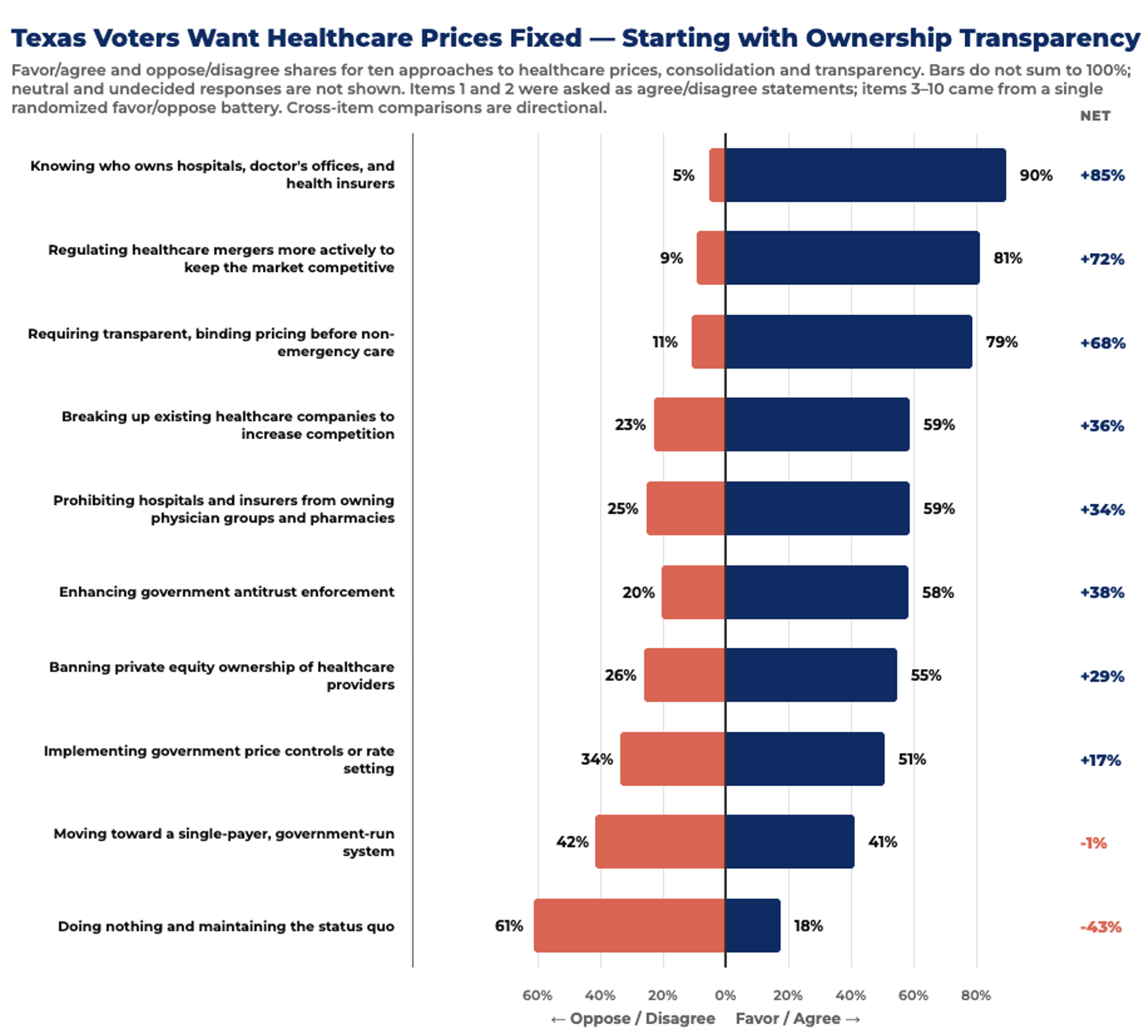
Supermajorities favor the right to know who owns a healthcare provider, price transparency in medical care and government regulation of healthcare mergers.
AUSTIN, TX, UNITED STATES, September 1, 2026 /EINPresswire.com/ -- With the affordability of healthcare top of mind for many Texans, new polling data from Texas 2036 suggests strong support for state action to improve transparency and competition in the healthcare market.
In its recent August 2026 survey of registered voters in the state, Texas 2036 found that four in five voters or more supported making it easier to know who owns your hospital or doctor’s office and to know the price of a medical procedure ahead of time.
The findings come as the Texas House Select Committee on Health Care Affordability, chaired by state Rep. James Frank, R-Wichita Falls, and vice chair state Rep. Toni Rose, D-Dallas, holds a hearing Tuesday after months of examining the forces driving healthcare costs and potential solutions.
Charles Miller, Texas 2036’s Director of Health and Economic Mobility Policy, will testify before the committee as an invited witness.
“Texans are looking for state government action on healthcare affordability,” Miller said. “They want real-time actionable information about service prices, more robust state action to promote sufficient competition in the healthcare market and, above all, for lawmakers to give serious attention to solutions that can bring prices down.”
These poll results, taken from the 10th edition of Texas 2036’s Texas Voter Poll, reflect widespread anxiety about rising prices in healthcare.
● 90% agreed Texans should have the right to know who owns their hospitals, doctors’ offices and health insurers, compared with just 5% who disagreed, an 85-point net margin.
● 81% support more active state regulation of health care mergers to maintain competition, compared with 9% who disagree, a 72-point net margin.
○ This is up from the 75% support that we registered the last time we tested this question in November 2024.
● 79% of voters favored requiring transparent and binding pricing before delivery of non-emergency care, and just 11% opposed it, a 68-point net margin.
Support also substantially outweighs opposition for several proposals aimed at increasing competition:
● Enhanced antitrust enforcement: 58% favor, 20% oppose, a +38-point net margin.
● Breaking up existing health care companies to increase competition: 59% favor, 23% oppose, a +36-point net margin.
● Prohibiting hospitals and insurers from owning physician groups: 59% favor, 25% oppose, a +34-point net margin.
● Banning private equity ownership of health care providers: 55% favor, 26% oppose, a +29-point net margin.
“Texas has an opportunity to become a national leader on reforms that make healthcare markets work better for patients, employers and taxpayers,” Miller said. “These recent poll results show that Texas voters are frustrated by not knowing what goes into their healthcare bills or who owns their healthcare provider. And they want change now.”
These findings build on previous Texas 2036 research and polling showing that healthcare affordability has become a major pocketbook issue for Texas voters. In late 2024, 71% of Texas voters said they were paying more for healthcare, including insurance premiums, deductibles and out-of-pocket expenses, than they had five years earlier.
The financial pressures are substantial. In 2025, the average annual premium for a family with employer-sponsored health coverage reached nearly $27,000. That figure, paid for by both employers and families, amounts to about a third of the median Texas household income.
Separate statewide polling has found that nearly nine in 10 Texans are concerned about healthcare prices, and 63% have delayed or skipped care because they couldn’t afford it. These pressures reflect a Texas healthcare market that isn't functioning effectively – one where prices increasingly reflect market power and limited competition rather than value and quality.
“Too often, healthcare affordability has been discussed primarily as a question of insurance coverage,” Miller said. “But Texans with insurance are feeling the squeeze too, through premiums, deductibles and out-of-pocket expenses. Rising healthcare prices put pressure on family budgets and make it more expensive for employers to provide coverage. The affordability challenge is much broader, and voters clearly recognize that.”
The new results do not suggest Texas voters agree on every possible approach. Government price controls or rate setting, for example, draw a much narrower margin of support, while voters are almost evenly divided over moving toward a single-payer, government-run system. The broader finding is more striking: on proposal after proposal aimed at transparency and competition, support substantially exceeds opposition.
Against that backdrop, Texas voters were clearest on one point: doing nothing is not acceptable. Among the approaches tested, maintaining the status quo was by far the least popular, with 61% of voters opposed to doing nothing and just 18% in favor, a 43-point net margin against the status quo. In fact, doing nothing drew the strongest opposition of any option tested.
“Texas has a real opportunity here,” Miller said. “Voters aren’t demanding one particular solution. They are giving state leaders room to work. The common ground is affordability, transparency and competition, and that’s a strong foundation for meaningful action.”
The 10th Texas Voter Poll was conducted Aug. 22-26 by Baselice & Associates for Texas 2036. The poll surveyed 1,369 registered voters, weighted to a base of 1,001. Margin of error: ±3.1%.
###
About Texas 2036
Texas 2036 is a nonprofit public policy organization committed to building long-term, data-driven strategies to ensure Texas’ prosperity up to its bicentennial and beyond. Our solutions are nonpartisan, grounded in thorough research and focus on critical issues that seek to improve lives and opportunities for all Texans.
Media Contacts:
Merrill Davis
Vice President of Communications, Texas 2036
Ph: 713-213-7297 / Email: merrill.davis@texas2036.org
John Reynolds
Director of Communications, Texas 2036
Ph: 512-468-7003 / Email: john.reynolds@texas2036.org
Merrill Davis
Texas 2036
+1 713-213-7297
email us here
Legal Disclaimer:
EIN Presswire provides this news content "as is" without warranty of any kind. We do not accept any responsibility or liability for the accuracy, content, images, videos, licenses, completeness, legality, or reliability of the information contained in this article. If you have any complaints or copyright issues related to this article, kindly contact the author above.
